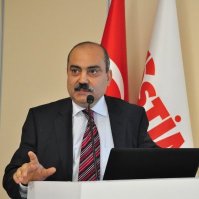
Rail System Supports within the Scope of the Local Development Initiative Incentive Program – Dr. İlhami Pektaş
The General Directorate of Development Agencies, an institution affiliated with the Ministry of Industry and Technology, is responsible for Türkiye’s regional development policies. It develops policies aimed at enabling cities to reach a minimum level of prosperity; ensuring local and regional development; reducing development gaps within and between regions; leveraging regional potential; utilising idle resources; activating competencies; meeting local needs; raising the level of technology production; and identifying regions’ sectoral priorities. In economic, social and cultural terms, these policies focus on strengthening the financial and technical capacity of regions and improving the investment environment.
The General Directorate oversees 26 Development Agencies across Türkiye, investment support offices operating in all 81 provinces, and four regional development administrations: GAP, DAP, KOP and DOKAP.
The mission of development agencies is to design city-based development policies within their regions of responsibility; analyse cities’ bottlenecks and develop solutions; introduce innovation; and foster sectors that can elevate regional potential and city opportunities to higher levels. In cities that are part of the rail systems ecosystem, Development Agencies provide support to move sectors—where initial clusters have formed and have reached a clustering level—towards more advanced stages.
In this context, the Ministry of Industry and Technology recently announced the Local Development Initiative Incentive Programme, which has been described as one of the most generous incentive schemes in Türkiye’s incentive history. Under this programme, four investment topics are identified for each province.
By focusing on cities’ needs, the programme determines four priority areas in each city through desk-based analyses and on-site consultations, with the objective of advancing existing economic depth, expanding and upgrading product portfolios, enabling more innovative production, and moving sectors to higher technology segments. High-level incentives are offered for these four priority areas, announced each year in January. Within this framework, incentives were recently announced through two programmes specifically related to rail systems.
Particularly for companies operating in the rail systems manufacturing industry—those making new investments or upgrading existing investments to produce new products—the programme offers customs duty exemptions and VAT support for imported machinery. In addition, the employer’s social security contribution is covered for up to 10 years by the state through the Ministry of Industry and Technology and Development Agencies.
Industrial investors may also be allocated investment land, either from Treasury land or through National Real Estate. As cash support, 15% of the investment amount is provided, up to TRY 301 million. Furthermore, interest/profit share support is offered at 20% of the fixed investment amount, again capped at TRY 301 million per investment. Significant tax reductions are also included: beyond VAT and customs duty exemptions, a corporate tax reduction is applied as an “investment contribution” at a 50% contribution rate. In practice, corporate tax relief may apply up to half of the fixed investment amount. For example, if an investor makes a TRY 1 billion investment, the portion up to TRY 500 million may be supported through corporate tax reductions until the investment is completed. The programme also includes Employer and Employee Social Security Premium supports. Overall, it is a highly comprehensive and generous support scheme.
Support Instruments
- Tax Reduction: 50% investment contribution rate
- Cash Support: 15% of the investment amount, up to TRY 301 million
- Interest / Profit Share Support: 20% of the investment amount, up to TRY 301 million
- Value Added Tax (VAT) Exemption
- Investment Land Allocation
- Customs Duty Exemption
- Employer Social Security Contribution Support: (12 years in Region 6; 8 years in other regions)
- Employee Social Security Contribution Support: (in Region 6 provinces)
Under this programme, rail systems-related investment calls were launched in 2025 for Eskişehir, Çorum, Konya and Sivas.
The first call was announced on 3 September 2025, and a two-stage process—pre-application and final application—was implemented through December. Investors with qualified feasibility studies applied to Development Agencies.
Significant rail systems investment applications were received nationwide. These will be finalised and implemented in the near term. The programme operates around four priority areas at the provincial level. Within the first call, investment topics were identified across a range of fields where Çorum, Eskişehir, Konya and Sivas were assessed to already have capability, or to be able to elevate capability, within the rail systems ecosystem.
A call for proposals has been launched to support the production of railway and tram wagons, freight wagon bogies, and coupling equipment in Çorum; the production of next-generation “Smart Wagons” to be used in the rail systems sector in Eskişehir; the manufacturing of parts for railway vehicles for rail transportation in Konya; and the manufacturing of mechanical fastening elements for the aviation, rail systems, and automotive industries, as well as electrical and other intermediate connection systems/equipment used in transportation vehicles in Sivas.
For 2026, investment topics were announced in January and published in the Official Gazette dated 31 January. Rail systems-related headings were specifically identified for Eskişehir, Bursa, Karabük, Kocaeli, Konya and Sivas. When determining these topics, detailed analyses are conducted province by province, including questions such as: What can Türkiye localise? Which products should be localised? Which products are not currently produced domestically but could be produced? Which products could help raise a city’s economic capacity through advanced technology and thus support local development?
For example, Bursa is a city specialised in the rubber sector. Under rail systems, the programme will support the production of high value-added products from rubber—such as rail systems bellows and shock/impact damping systems. Under “High Value-Added Rubber Product Manufacturing,” items such as seismic isolators; bellows for rail systems/buses; shock-impact damping systems; landing gear parts for aircraft; vibration prevention systems and similar products will be supported. If investors in Bursa have interest, feasibility and production capability for these headings, they may apply to the call.
For other provinces, examples of supported investment topics include:
- Eskişehir: production of parts for railway vehicles for rail transportation; testing and certification; composite bodies; traction motors; automatic doors and systems; chassis and bogie structural parts; and mechanical subsystems
- Sivas: production of mechanical and electrical connection elements for the aviation, rail systems and automotive industries
- Karabük: high value-added steel-based long products; wheels for urban rail vehicles; high-speed train wheels; train axles and wheelsets; qualified fasteners; and special-geometry, high-strength fasteners such as bolts and nuts
- Kocaeli: buffers and impact dampers for rail systems; elastomer suspension and spring systems; elastomer rail and sleeper pads; vibration and noise isolators; rubber connection elements; sealing and bellows components
- Konya: pantographs for railway vehicles; braking systems; traction motors; bogies and related components
Within this scope, calls were issued and product specifications for the identified items were shared.
All information can be accessed via the following portals: https://yerelkalkinmahamlesi.sanayi.gov.tr/
Additionally, there is a platform (https://www.yatirimadestek.gov.tr/) that brings together all government incentives under a single portal. It includes not only the supports provided by development agencies, the Ministry’s Incentive Implementation schemes, or institutions such as TÜBİTAK and KOSGEB, but all government supports in one comprehensive platform accessible through a single portal. You can access all government incentives through this portal.